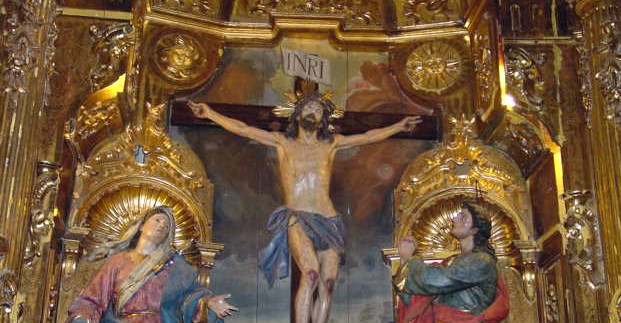
Crucifix of Limpias came alive and wounds wept blood
From
[Miraculous
Images of Our Lord], by Joan Carroll Cruz,
published by TAN Books and Publishers
(1993) Used with permission.
| Limpias, Santander, Spain Late Seventeenth Century
When entering the sixteenth-century Church of St. Peter, attention is immediately captured by the beautiful life-size figure of the crucified Savior located above the main altar. Arranged on either side of the crucifix, and somewhat below it, are larger-than-life size figures of the Sorrowful Mother and St. John the Apostle. Believed to have been the work of Pedro de Mena, who died in 1693, the crucifix was given to the church by Don Diego de la Piedra Secadura, who had been born at Limpias in 1716. The crucifix is a meditation on the sufferings of Our Lord and is thought to portray the Crucified in the final moments of His agony. Measuring six feet tall, the corpus is clothed with a loin cloth that is held in place with a rope. The feet are one atop the other and are pierced with a single nail. The index and middle fingers of both pierced hands are extended as though giving a final blessing. The face of Our Lord is of a particular beauty, with it's eyes of china looking towards Heaven so that, for the most part, only the whites of the eyes are visible. The first recorded miracle involving this crucifix took place in 1914, five years before the grand miracles of 1919. The recipient of the favor was Don Antonio Lopez, a monk belonging to the Order of the Pauline Fathers who conducted a college in Limpas. his entire account reads as follows: One day in the month of August, 1914, I went into the parish church of Limpias, by order of my friend D. Gregorio Bringas, to fix the electric light over the high altar. In order to work more comfortably I put two large cases on the altar, an on them a ladder, the ends of which I leaned against the wall that serves as a background to the figure of the Crucified One. After I had worked for two hours, in order to rest myself a little I began to clean the figure so that it could be seen more clearly. My head was on a level with the Head of Christ, and at a distance of only a couple of feet from it. It was a lovely day and through the window in the sanctuary a flood of light streamed into the church and lit up the whole altar. As I was gazing at the crucifix with the closest attention, I noticed with astonishment that Our Lord's eyes were gradually closing, and for five minutes I saw them quite closed. Overwhelmed with fright at such an unexpected spectacle, I could still hardly quite believe what I saw, and was about to come down from the ladder. Notwithstanding, my bewilderment was so great that my strength suddenly failed me; I lost my balance, fainted, and fell from the ladder onto the edge of the altar itself and down the steps into the sanctuary. Another Miracle was when Archpriest D. Eduardo Miqueli was celebrating Holy Mass, both missionaries were occupied in the confessional. Fr. Agatangelo, however, delivered the day's sermon based on the words "My son, give me thy heart." (pro.23:26). While he was speaking, a girl of about 12 entered the confessional of Fr. Jalon and told him the eyes of Christ on the cross were closed.Thinking that her claim was a product of her imagination, the priest ignored her claim until other children also came to him with the same message. After the parish priest was called from the sacristy and was told the eyes of the Crucified were opening and closing and that the figure was turning His gaze from side to side, he, too, fell on his knees to pray. But his prayer was soon interrupted by many of the people who declared that the figures was perspiring. Fr. Jalon climbed up and saw that the perspiration covered the figures neck and chest. after touching the neck he looked upon his fingers that were wet with the fluid. As verification of what had taken place, he showed his moistened fingers to the congregation. Fr. Agatangelo later saw the miracle several times when he prayed alone in the church at night. Another apparition took place on Palm Sunday, April 13, 1919, when two prominent men of Limpas approached the altar. Speaking of hallucination and mass hysteria as they looked upon the crucifix, one of them suddenly pointed upward and feel to his knees, crying for mercy and proclaiming his belief in the miracle. On Easter Sunday April 20, in the presence of a group of nuns know as the Daughter of the Cross who conducted a girls school in Limpas. They saw the eyes and lips of Santo Cristo move. Rev. Baron Von Kleist reports that: Many said the
Savior looked at them; at some in a kindly manner, and at others gravely, and
at yet others with a penetrating and stern glance. Many of them saw tears in
His eyes; others noticed that drops of blood ram down from the temples pierced
by the crown of thorns; some saw froth on His lips and sweat on His body;
others again saw how He turned His eyes from side to side, and let His gaze pass
over the whole assembly of people; or how; at the Benediction, He made a movement
of the eyes as if giving the bless; how at the same time He moved the thorn- crowned
head from on side to the other. Others had the impression that a deep, submissive
sigh was wrested from His breast, some believed they saw Him whisper-in short,
the most varied manifestations were observed on this crucifix.
One of the first to declare his experience to the secular press was the well-known and highly respected D. Adolf Arenaza. His testimony was published May 5, 1919 in the newspaper La Gazeta del Norte, which was published in Bilbao. He reported that he joined a procession going to Limpas in order to visit the crucifix. While looking through his field-glasses he saw the movement of the eyes four times. He further stated that it could not have been and effect of the light nor and hallucination, since people saw the miracles from all parts of the church. He then asked, "Does Our Lord really move His eyes... I am rather of the opinion that He really does move them, for I have seen it myself." Several albums are found in the sacristy of the church of the Limpias. these contain well over 8,000 testimonies of people who had seen the wonderful apparitions. Of these 2,500 were sworn on oath. The first Bishop to be favored with an apparition was Don Manuel Ruiz y Rodriguez of Cuba, who went to Limpas following a visit to Rome. After returning home he composed a detailed pastoral letter to the members of his diocese in which he told of the miraculous crucifix. He disclosed that he had seen the figure close and open the mouth, how it moved it's head from one side to the other how the face took on an expression of Death. Later he again saw the mouth move. "He shut it very slowly but opened it quickly... the closing of the mouth was slow until one lip touched the other. Finally a report made by a medical student D. Heriberto de la Villa which was published in the paper Del Pueblo Astur on July 8, 1919. Little by little the breast and face became dark blue, the eyes move to the right then the left, upwards and down, the mouth somewhat open, as if He was having breathing difficulty. I also noticed that above the left eyebrow a wound formed, out of which a drop of blood flowed over His eyebrow, and remained stationary by the eye-lids. I believe it is my duty to swear upon oath what I had seen, and I did so in the sacristy of the church. I will conclude with a brief report made by a journalist. After watching the movement of the eyes and mouth he stated:I could perceive two movements of the jawbone, as if He were saying two syllables with His lips. I shut my eyes quite tight and asked myself: "What will He have said?" The answer was not long in coming, for in my innermost self I clearly heard the significant and blessed words, "Love Me!" Perhaps that is why Our Lord performed so many wonders for eyes of believers and unbelievers. At Limpas He demonstrated the agony of His death and the extent of His love for us, not only to evoke sentiments of pity and repentance, but also to ask, no, to plead with us to love Him in return.
|