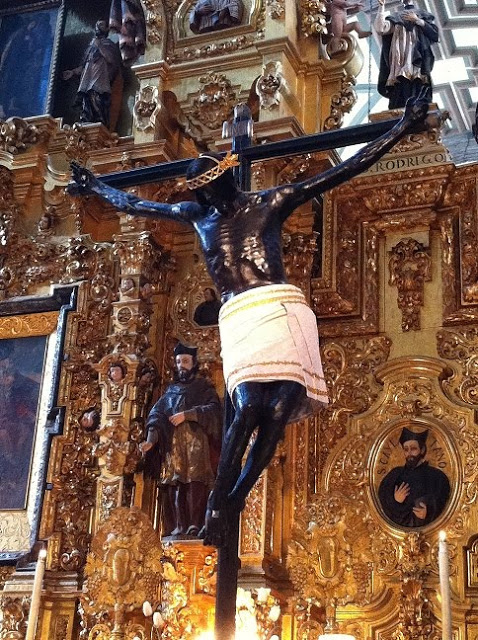
The Miraculous Crucifix of Our Lord of the Poison
From [Miraculous Images of Our Lord], by Joan Carroll Cruz, published by TAN Books and Publishers (1993) Used with permission.
The almost life-size figure of the crucified Savior which was enshrined above an altar in the Dominican church named Porta Coeli was customarily visited by a holy priest whose name has been lost to us. After praying before the seventeenth-century image, the priest always finishes his devotions by reverently kissing the feet of the Crucified. One day, while an enemy of Christianity prowled about the church, the saw the priest devoutly kissing the feet of the image of Our Lord. After learning that it was the custom of the holy priest to visit the crucifix each day and kiss it, the scoundrel devised a sacrilegious plan. When the church was empty, the enemy stole inside and approached the crucifix. Taking from his clothing a bottle and a small cloth, he carefully poured a liquid onto the cloth and then rubbed the cloth on the feet of the Crucified. The liquid was a deadly poison whose effects had been proven to be almost instantaneous. When the cleric next visited his beloved Crucifix he prayed, as was custom, and then approached the feet for the usual kiss. But as he prepared to kiss the image, the Crucified, always a flesh color, turned immediately to jet black. Horror-stricken at the sudden change, the priest stood motionless while the witnesses, thoroughly terrified at what they had seen, rushed outside to notify the people in he street. When word of the miracle reached the ears of the would-be-assassin, he hurried to the church in disbelief. Upon seeing the image he fell to his knees beside the priest, and with tears of repentance told the priest of his actions. He asked forgiveness, received absolution and thereafter led a virtuous an holy life. As a result of the miracle, the people had an even greater devotion to the image. Not only did it receive the homage of the people in the city, but countless others also came from outlying areas to offer their veneration and love. The Holy Crucifix still receives the devotion of the Mexican people, but it especially attracts the attention of countless pilgrims who visit it after acknowledging their love and devotion to the image of Our Lady of Guadalupe. The miraculous image of Our Lord of the Poison is found in a beautiful side chapel in the Cathedral Metropolitana De Mexico in Mexico City.
|