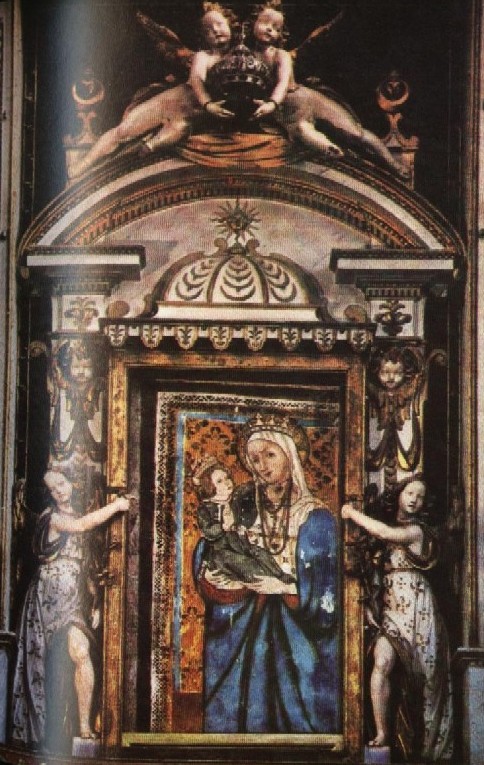
Madonna of the tears weeps blood Trevi, Italy
|
From [Miraculous
Images of Our Lady], by Joan Carroll Cruz,
Tervi, Umbria, Italy 1485 - The painting of religious portraits on the outside walls of homes, especially thoses of stucco, was custonary durning the fifteenth centery as it is today in many Eurpope cities. In Trevi this artwork was assigned to students of a nearby school conducted by Pietro Vannucci, a master painter. The moddest home of Diotallevi d'Antonio Santilli, locatated on the road between Spopeto and Trevi, was similarly decorated when a portrait of the Madonna was painted on the outside wall on October 4, 1483 the feastday of St. Francis of Assisi. The miracle of the tears took place two years later, on Auguest 5, 1485. On that day a passerby nticed moisture on the wall and discovered that it originated from the eyes of the Madonna. These were no ordinary tears, but those of blood. One can only imagine the excitement this event created. Neighbors flocked to the house to see the prodigious occurrences of blody tears falling from the eyes of a Madonna painted on a stucco wall. new spread quickly to people in nearby villages: they likewise hurried to the house to see the miracle of the bloody tears. Disbelivers and skeptics came and were convinced. Many of thehese doubters and others recieved spirtiual graces and miracles of healing. A notary of Trevi was alerted and he, too, rushed to the scene. He described the prodigy in writing and recounted all the miracles that he witnessed.His document, as well as other official records that were made by the municipal authorities, can be found in the archives of the City of Trevi. Also preserved is another contemporary account of the miracle and the origin of the shrine. This was written by Fr. Francesco Mugnoni, an Olivetan, who resided a short distance from the house of the miracle. The reason for the tears was a matter of great concern and speculation until it was finally decided that they represented the sympathy of the Madonna for the pestilence which for years had tormented the territory around the city of Trevi. On August 21, 1485 one week after the start of the miracle, the first Holy Mass was offered in the small chapel that had been hastily erected near the wall of the Madonna. Permission was soon received for a daily Mass to be offered in this little improvised chapel. Because space was inadequate from the start, plans were soon made to replace the chapel with a magnificent building worthy of the Mother of God. Monies were collected, and work was begun on March 27, 1487. The community entrusted the building to Antonio Marchisi of Settignano. The magnificent portal and stonework were designed and executed by John di Giampietro of Venice. The interior was beautified with the paintings of pietro Vannucci, who conducted the school of art in Trevi. The sculptures are credited to Giovanni of Carrara. When the church was completed, the portion of the wall that was covered with the portrait of the Madonna was cut from the wall of the house and removed to the church, where it now receives the admiration and attention of the Madonna's devotees.Soon a house for religious was built near the church. First entrusted to the Olivetans, it was later occupied in turn by various religious orders. Always regarded as the patroness of the city, the Madonna of the Tears was officially designated as such on July 26, 1846.The shrine has been enriched with many ex-votos which signify the numerous benefits conferred upon the people of the city and visiting pilgrims through the intercession of the Madonna of the Tears. One of the most outstanding of these tributes is a relief in silver depicting the City of Terni, which was presented in thanksgiving for the deliverance of that city from the plague. The feast of the Madonna is celebrated on the Sunday after Easter. |