 |
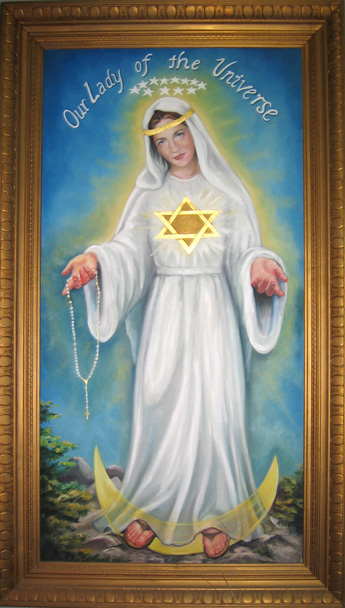
The Boy who saw The Virgin - The Bronx Miracle
|
|
|
See [here] and [here] a November 26th 1945 Life Magazine article about The Bronx Miracle.
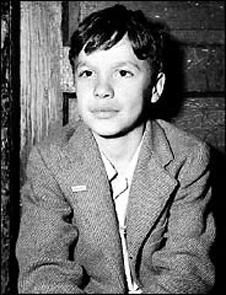 |
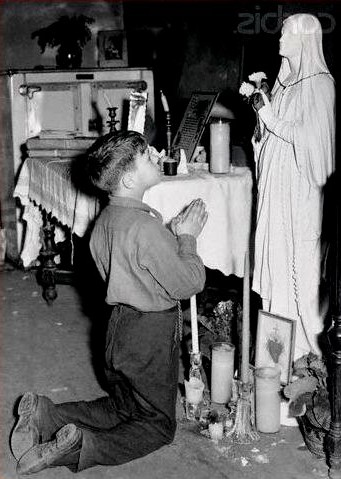
December 22, 2002 - Reported in The [New York Times]. Written by Peter Duffy. Every evening at 7, Joseph Vitolo walks out the backdoor of his boyhood home in the Bronx and ascends a long stairway to a shrine that overlooks the northern tip of the Grand Concourse. He then leads the few people who have gathered in the recitation of the rosary. On some nights, no one shows up and he performs the service alone. Other nights, Mr. Vitolo is himself absent, having fallen asleep in front of the television set or lost track of the time. Mr. Vitolo, a slow-moving 66-year-old with a gravelly voice and sandy hair flecked with gray, has sought to carry out this nightly act of devotion since Oct. 29, 1945. That is when, at 9, he said he witnessed the Virgin Mary hovering over the spot where the shrine is now. The sighting catapulted Mr. Vitolo, a child of Italian immigrants, to news media celebrity. Spurred by extensive newspaper coverage, more than 30,000 people eventually crowded the spot, just south of Van Cortlandt Park, hoping to be touched by the heavenly presence that, it was said, had been communicated to the child. |
|
The vision arrived just a few months after the end of World War II. Boatloads of joyous servicemen were returning to the city from overseas. New York was unassailably confident. "All the signs were that it would be the supreme city of the Western world, or even the world as a whole," Jan Morris wrote in her book "Manhattan '45." New Yorkers, she added, using a phrase from an upbeat business pamphlet of the time, saw themselves as a people "to whom nothing is impossible." This particular impossibility, the vision, soon faded from the headlines. The Archdiocese of New York declined to make a statement on its validity, and as the days and months and years passed, local Roman Catholics forgot about the "Bronx Miracle," as Life magazine called it. But young Joseph Vitolo never forgot, not during Christmastime nor at any other seasons of the year. He visited the spot each night, a practice that alienated him from pals in his Bedford Park neighborhood, who were more interested in going to Yankee Stadium or Orchard Beach. Many in the working-class area, even some adults, mocked him for his piety, derisively calling him "St. Joseph." Through years of poverty, Mr. Vitolo, a modest man who works as a janitor at Jacobi Medical Center and prays that his two grown daughters find good husbands, has maintained this devotion. Whenever he tried to begin a life away from the apparition site - he twice attempted to become a priest - he found himself drawn back to the the old neighborhood. Today, sitting in his creaky three-story house, Mr. Vitolo said the moment changed his life, made him better. He has a fat, treasured scrapbook of clippings about the event. But his life did peak at a tender age - what could compete? - and there is a weariness, a guardedness, about him, stemming maybe from both his earthly struggles and from the burden of being the boy who saw the Virgin. Did he ever question what his eyes saw? "I never had doubts," he said. "Other people did, but I didn't. I know what I saw." The amazing tale began two nights before Halloween. Newspapers were full of stories about the destruction the war had wrought in Europe and Asia. William O'Dwyer, an Irish-born former district attorney, was days away from being elected mayor. Yankee fans were lamenting their team's fourth-place finish; its top hitter had been second baseman Snuffy Stirnweiss, not exactly Ruth or Mantle. Joseph Vitolo, the baby of his family and small for his age, was playing with friends when suddenly three girls said they spotted something above a rocky hill behind Joseph's house, on Villa Avenue, a block from the Grand Concourse. Joseph said he didn't notice anything. One of the girls suggested that he pray. He whispered an Our Father. Nothing happened. Then, with greater feeling, he recited a Hail Mary. Instantly, he said, he saw a floating figure, a young woman in pink who looked like the Virgin Mary. The vision beckoned to him by name. "I was petrified," he remembered. "But her voice calmed me down." He warily moved closer and listened as the vision spoke. She asked him to the spot for 16 consecutive nights to say the rosary. She told him that she wanted the world to pray for peace. Unseen by the other children, the vision then disappeared. Joseph rushed home to tell his parents, but they had already heard the news. His father, a garbage collector who was an alcoholic, was outraged. He slapped the boy for telling lies. "My father was very tough," Mr. Vitolo said. "He would beat my mother. That was the first time he hit me." Mrs. Vitolo, a religious woman who had had 18 children, only 11 of whom survived infancy, was more sympathetic to Joseph's tale. The following night she accompanied her son to the site. The news was spreading. That evening, 200 people gathered. The boy knelt on the ground, began to pray and reported that another vision of the Virgin Mary had appeared, this time requesting that everyone in attendance sing hymns. "As the throng worshipped in the open air last night and lighted votive candles in the form of a cross, . . . at least 50 motorists stopped their cars near the scene," wrote George F. O'Brien, a reporter for The Home News, the major Bronx daily. "Some knelt near the curb when they heard of the occasion for the gathering." Mr. O'Brien reminded his readers that Joseph's story was similar to that of Bernadette Soubirous, the poor shepherd girl who claimed to see the Virgin Mary in Lourdes, France, in 1858. The Roman Catholic Church recognized her visions as authentic and eventually declared her a saint, and the 1943 film about her experience, "Song of Bernadette," won four Academy Awards. Joseph told the reporter that he had not seen the film. In the next few days, the story leapt fully into the spotlight. Newspapers published staged photographs of Joseph kneeling piously on the hill. Reporters from Italian newspapers and international wire services showed up, hundreds of articles circulated around the globe, and people eager for miracles arrived at the Vitolo home at all hours. "I couldn't go to sleep at night because people were constantly in the house," Mr. Vitolo said. Lou Costello of Abbott and Costello sent a small statue encased in glass. Frank Sinatra brought a large statue of Mary that still sits in the Vitolo living room. ("I just saw the back of him," Mr. Vitolo said.) Cardinal Francis Spellman, the archbishop of New York, swept into the Vitolo home with a retinue of priests and spoke briefly with the boy. Even Joseph's drunken father regarded his youngest child differently. "He said to me, 'Why don't you cure my back?' Mr. Vitolo recalled. "And I put my hand on his back and I said, 'Papa, you're better.' He went back to work the next day." But the boy was overwhelmed by all the attention. "I didn't understand what it was all about," Mr. Vitolo said. "People were charging at me, looking for help, looking for cures. I was young and confused." By the seventh night of the visions, more than 5,000 people were packing the area. The crowd included sad-faced women in shawls fingering rosary beads; a contingent of priests and nuns who were given a special area in which to pray; and well-dressed couples who had arrived from Manhattan in limousines. Joseph was carried to and from the hill by a bulky neighbor, who protected him from overeager worshippers, some of whom had already torn the buttons from the boy's coat. After the services, he was placed on a table in his living room as a slow procession of the needy paraded before him. Unsure of what to do, he placed his hands on their heads and recited a prayer. He saw them all: veterans wounded on the battlefield, elderly women who had trouble walking, children with schoolyard injuries. It was as if a mini-Lourdes has arisen in the Bronx. Not surprisingly, stories of miracles quickly surfaced. Mr. O'Brien reported the story of an infant whose paralyzed hand was repaired after touching sand from the site. On Nov. 13, the second to last evening of the prophesied appearances, more than 20,000 people showed up, many via chartered buses from Philadelphia and other cities. The final night promised to be the most spectacular. The newspapers were reporting that the Virgin Mary had told Joseph that a well would miraculously appear. Anticipation was at a fever pitch. As a soft rain fell, between 25,000 and 30,000 people settled in for the service. The police closed a section of the Grand Concourse. Carpets were placed on the path leading up to the hill to prevent pilgrims from falling into the mud. Then Joseph was delivered to the hill and placed among a sea of 200 flickering candles. Wearing a shapeless blue sweater, he began to pray. Then someone in the crowd shouted, "A vision!" A surge of excitement shot through the gathering, until it was discovered that the man had caught a glimpse of a female spectator dressed in white. That was the most gripping moment. The prayer session proceeded as it usually did. After it was over, Joseph was carried home. "I remember hearing people yelling when they were taking me back," Mr. Vitolo said. "They were shouting: 'Look! Look! Look!' I remember I looked back and the sky had opened up. Some people said that they saw Our Lady in white ascending into the sky. But I only saw the sky opening up." The heady events of fall 1945 marked the end of Joseph Vitolo's childhood. No longer an ordinary child, he had to live up to the responsibility of someone who had been graced by a godly spirit. So every night at 7, he dutifully walked up the hill to recite the rosary for the progressively smaller crowds who were visiting a spot that was being turned into a shrine. His faith was strong, but his constant religious devotions caused him to lose friends and do poorly in school. He grew into a sad, lonely boy. The other day, Mr. Vitolo sat in his drafty living room, recalling that past. In one corner is the statue that Sinatra brought, one of its hands damaged by a fallen chunk of ceiling. On the wall is a brightly colored painting of Mary, rendered by the artist according to Mr. Vitolo's instructions. "People would make fun of me," Mr. Vitolo said of his youth. "I would walk down the street and grown men would yell out, 'There he goes, St. Joseph.' I stopped walking down that street. It wasn't an easy time. I suffered." When his beloved mother died in 1951, he tried to give his life direction by studying to become a priest. He dropped out of Samuel Gompers Vocational and Technical High School, in the South Bronx, and enrolled at a Benedictine seminary in Illinois. But he quickly soured on the experience. His superiors expected a lot out of him - he was, after all, a visionary - and he wearied of their high hopes. "They were beautiful people, but they scared me," he said. Aimless, he enrolled in another seminary, but that plan failed, too. He then found a job in the Bronx as a printing apprentice and resumed his nightly devotions at the shrine. But over time he grew annoyed by the responsibility, sick of the crackpots, and sometimes resentful. "People were asking me to pray for them, and I was looking for help myself," Mr. Vitolo said. "People would ask me, 'Pray that my son gets into the Fire Department.' I would think, Why doesn't somebody get me a job in the Fire Department?" Things began to look up in the early 1960's. A new group of worshipers became interested in his visions, and, inspired by their piety, Mr. Vitolo resumed his dedication to his encounter with the divine. He grew close to one of the pilgrims, Grace Vacca of Boston, and they were married in 1963. Another worshiper, Salvatore Mazzela, an auto worker, bought the house next to the apparition site, ensuring its safety from developers. Mr. Mazzela became the shrine's guardian, planting flowers, building walkways and installing statues. He himself had visited the shrine during the 1945 apparitions. "A woman in the crowd said to me, 'Why did you come here?,' " Mr. Mazzela recalled. "I didn't know what to answer. She said, 'You came here to save your soul.' I didn't know who she was, but she made me see. God made me see." Even during the 1970's and 80's, as much of the Bronx was overtaken by urban decay and ballooning crime, the little shrine remained a peaceful oasis. It was never vandalized. Over these years, most of the Irish and Italians who had frequented the shrine moved to the suburbs and were replaced by Puerto Ricans, Dominicans and other Catholic newcomers. Today, most passers-by know nothing of the thousands of people who had once gathered there. "I've always wondered what it was," said Sheri Warren, a six-year resident of the neighborhood, who was returning from the grocery store on a recent afternoon. "Maybe it happened a long time ago. It's a mystery to me." Today, a glass-enclosed statue of Mary is the shrine's centerpiece, elevated on a stone platform and set at exactly the spot where Mr. Vitolo said the vision appeared. Nearby are wooden benches for worshipers, statues of St. Michael the Archangel and the Infant of Prague and a tablet-shaped sign with the Ten Commandments. But if the shrine remained vital through those decades, Mr. Vitolo struggled. He lived with his wife and two daughters in the ramshackle Vitolo family home, a creaky three-story structure just a few blocks from St. Philip Neri Church, where the family has long worshiped. He worked at various menial jobs to keep the family from poverty. In the mid-70's, he was employed at Aqueduct, Belmont and other local racetracks, collecting urine and blood samples from the horses. In 1985 he joined the staff of Jacobi Medical Center, in the northern Bronx, where he still works, stripping and waxing the floors and rarely revealing his past to co-workers. "I had enough ridicule as a young boy," he explained. His wife died a few years ago, and Mr. Vitolo has spent the last decade worrying more about the heating bills for the house, which he now shares with one daughter, Marie, than about increasing the shrine's attendance. Next door to his house is an abandoned, littered playground; across the street is Jerry's Steakhouse, which did spectacular business in the fall of 1945 but now sits vacant, marked by a rusting 1940's neon sign. Mr. Vitolo's dedication to his shrine persists nonetheless. "I say to Joseph that the authenticity of the shrine is his poverty," said Geraldine Piva, a devoted believer. "He's never made any money from the shrine." For his part, Mr. Vitolo says that an unswerving commitment to the visions gives his life meaning and protects him from the fate of his father, who died in the 1960's. He is energized each year, he says, by the anniversary of the Virgin's appearances, which is marked with a Mass and celebrations. Devotees of the shrine, now numbering about 70 people, travel from several states to attend. The aging visionary has flirted with the idea of moving - perhaps to Florida, where his daughter Ann and two of his sisters live - but he cannot abandon his sacred spot. His creaky bones make the walk up to the site difficult, but he plans to make the climb for as long as he can. For a man who long struggled to find a career, the visions of 57 years ago have turned out to be a calling. "Maybe if I could take the shrine with me, I would move," he said. "But I remember, on the last night of the visions in 1945, the Virgin Mary didn't say goodbye. She just left. So, who knows, someday she might be back. If she does, I'll be here waiting for her."
Our Lady of the Universe shrine entrance is at 3191 Grand Concourse, Bronx, NY 10468. |