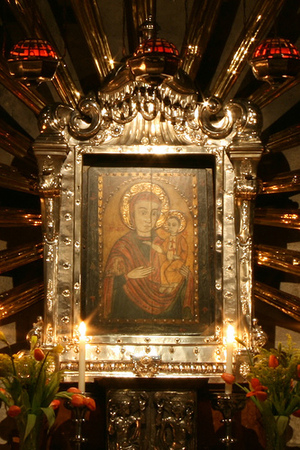
The Weeping Icon of Marijapovch
|
|
Among Carpatho-Rusyn Christians, the [Weeping Icon of Marijapovch] is revered because it stands for believers as a witness to the protection and intercession of the Most Holy Mother of God. The icon itself comes from and expresses the life of the Church in Eastern Europe. Its rich history reflects a deeply rooted faith in God and a trusting devotion to the Mother of God. In the northeastern plains of Hungary, in the village of Povch (former Szabolcs County), stands the Monastery of the Basilian Fathers, with a magnificent church. Stefan Papp, brother of the pastor of the church in Povch, who had studied art in Italy, was engaged by Laszlo Csigri to write an icon of the Mother of God for the ikonostas. He painted the Virgin Mother on wood holding the Divine Infant with a three-petaled tulip in His hand. Unable to pay for the icon, Lorincz Hurta, a well-to-do parishioner, donated it to the church. In this church the first weeping of the icon of the Mother of God took place on November 14, 1696 according to the Julian calendar. The same miracle occurred again from December 8 to 19th of the same year. Needless to say, this miracle was a great consolation to the discouraged people of Povch. Ever since the first miraculous weeping, the village of Povch has been called Marijapovch (in Hungarian, Máriapócs). When Leopold I, Emperor of Austria, had been informed of the miraculous icon, he immediately had it transferred to Vienna. This royal act did not please the people of Povch and they very reluctantly parted with the holy icon. On December 1, 1697, the icon was placed above the tabernacle of the main altar in St. Stephen’s Basilica in Vienna. During the Second World War it was taken down to the grottoes of the basilica for safe-keeping. After the war it was placed above a new altar with a baldachin, close to the main entrance on the right-hand side of the basilica. The carriage transporting the icon was delayed at each post depot on the route to Vienna by large groups of people, who had gathered to pay homage to the icon. Count Carbelli, a chamberlain of Emperor Leopold I, was so impressed by the piety and devotion of the crowds that he ordered a Jesuit Father from Košice to come to Barca, Abauj County, to make a copy of the icon for the church at Povch. When the icon was completed, the people formed a procession and carried the new icon to Marijapovch. This second icon of Marijapovch began to shed tears on the first, second, and third of August in 1715. Devotion to the holy icon increased and the church at Marijapovch became a most renowned place of pilgrimage. Nearly two centuries passed before the third shedding of tears which took place in December 1905. |