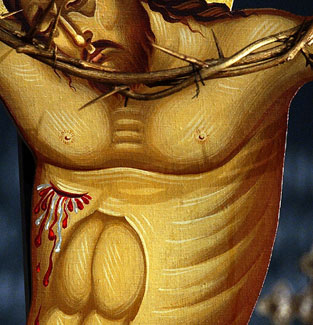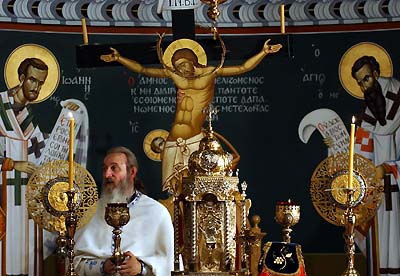
Oil seeping from head, torso and feet of the Crucified Christ Bethlehem, PA
|
|
March 26, 2004 - Reported in the [morningcall.com]. Written by Dan Sheehan. Believers say oil is seeping from icon in Bethlehem. Unexplained event at St. Nicholas Greek Orthodox Church began with Great Lent. The liturgy done, the crowds gone, the perfume of incense fading, the Rev. Michael Varvarelis led two visitors to the front of St. Nicholas Greek Orthodox Church on Thursday and gestured at the 9-foot cross behind the altar. Under the lights, vertical streaks of oil glistened on the head, torso and feet of the painted Christ. Varvarelis said the 25-year-old icon at the Bethlehem church began exuding the colorless, odorless oil in late February, at the beginning of the Orthodox holiday of Great Lent. The strength of the flow has diminished since, but it hasn't stopped. A blessing, declared Metropolitan Maximos, bishop of the Greek Orthodox Diocese of Pittsburgh, when he visited the church two weeks ago at Varvarelis's request to examine the cross. St. Nicholas is part of the Pittsburgh Diocese. The metropolitan said the oil would serve to draw attention to the cross and its meaning. He did not call it a miracle, though some in this church of 700 families are inclined to believe it is one. "What message is trying to send us?" wondered Varvarelis's wife, Maria, discerning a divine hand at work behind the oil. "Sometimes a little sign like this makes you nervous, because you don't know what might happen. But we are excited about it." This month, at a Roman Catholic church in Medford, Mass., parishioners reported seeing a statue of the [Virgin Mary shedding tears]. Varvarelis said he is familiar with many [occurrences] of Orthodox icons producing tears or oils. He has no plans to have the St. Nicholas oil analyzed, though he said he would not object to the procedure. "Come," he invited skeptics who would turn a microscope on the matter. Gregory Ferguson, a chemistry professor at Lehigh University in Bethlehem, said an analyst might be able to come up with a hypothesis about the oil's origins. "It's important to recognize that even if one did that, it doesn't diminish the spiritual importance of what's happening," he said. "Science and theology are not opposed to one another. They are complementary ways of viewing the world. They're different, but not opposed." From afar, the cross at St. Nicholas which stands behind the altar in a wooden base looks like painted wood. It is actually wood covered in painted canvas, said its creator, George Fillipakis, a renowned iconographer from New York who has created religious images for 55 Orthodox churches in America since moving to this country from Greece in 1969. Fillipakis said the wood was ordinary plywood, "the kind you make cabinets from," and the paints were blended from dry pigments and egg whites. Perhaps the emission of oil is some sort of chemical or atmospheric reaction, he said, "but why does it happen from this one and not other ones?" Or perhaps it is something else, Fillipakis suggested, some heavenly nudge toward devotion in the thick of the Lenten season. "I don't know exactly what the message is, but I believe the oil coming out is holy oil, " he said. "If you are religious, you have to accept that oil as a miracle."
April 4, 2004 - Pilgrims flock to local icon. Reported in the [lehighvalleylive.com]. Written by John Zukowski. Jennifer Shupp of Northampton went to St. Nicholas Greek Orthodox Church in Bethlehem to see what she thought might be a miracle. "When it's so close, how could you not come see it?" said Shupp, a Roman Catholic. "It's special regardless of what religion you are." A woman from Bath who did not give her name also came to see what she thought was evidence of the divine. "I think he's trying to send us a message," she said looking reverently at an icon of a bleeding, suffering Jesus on a wooden cross. What is drawing visitors each day to the church is oil seeping from an icon behind the church altar. Church authorities aren't officially calling the unexplained oil a miracle. There are no plans to have the substance scientifically tested. But some people who have seen it believe the seeping oil is produced by divine means. St. Nicholas' senior pastor, the Rev. Michael Varvarelis, first spotted it at the beginning of the Lenten season. He saw a substance coming from several parts of the image of Jesus' body. The oil caused light streaks. Some of it also dripped from the image of Jesus' feet at the bottom of the icon. After the oil continued to seep from the icon, Varvarelis invited Metropolitan Maximus from the Greek Diocese of Pittsburgh to examine it. Maximus is the spiritual Greek Orthodox leader of 52 parishes, including 29 Pennsylvania parishes. "He was quite moved by it and considered it a blessing for the church and people in the Lehigh Valley," Varvarelis said. Church officials didn't publicize the icon. But news about it spread without church authorities notifying anyone. People have started coming to see it regularly. "We've had people come from New Jersey, Reading, Wilkes-Barre and all over the Lehigh Valley," said congregation member George Pitsilos. So the church on Union Boulevard started showing the icon to what Varvarelis calls the pilgrims who flock to the church each day. Pitsilos is often there between 4 and 6 p.m. to show the icon. Varvarelis also has shown it to visitors, some of whom have never been inside an Orthodox church before. "I've seen people look at it with tears streaming down their cheeks," Varvarelis says. "They say they hear about these things in far away places, but here is something right here in the Lehigh Valley." The icon is behind an icon screen, a section of the church usually reserved for clergy. Visitors usually stand in a doorway to look at it. Icons in the Orthodox Church are painted by church artists called iconographers. The icon at the Greek Orthodox Church is attached to a wooden cross. In the Orthodox Church, icons are considered not to have power by themselves. But the church has a history of what are called "[miracle icons]." "Icons are the point where the divine meets the human world," says Michael Dahultea, dean of St. Tikhon's Orthodox Seminary in South Canaan, Pa. "If an icon has a miracle, it is done by the figure in heaven who the icon represents. If the icon in Bethlehem is of Jesus, then it would be Jesus who is working the miracle." Varvarelis considers the substance from St. Nicholas' icon a joyous event. "It's because of the oil," he said. "Oil is always for healing." For visitors who want to bless something with the oil, church officials rub the oil onto cotton swabs. The swabs are carefully wrapped and put into plastic pouches. Some recent visitors said they planned to take a swab home to bless family members with it. Sometimes people rub the substance onto hands in the shape of a cross, Pitsilos said. The church has no plans to test the substance. In a well-publicized incident in Chicago in 1986, an Illinois Metropolitan also decided to not have a so-called miracle icon tested. That was after an [icon of the Virgin Mary started shedding tears], an event that drew people from all over the United States to see it. "Testing is irrelevant because it's an expression of faith, and those who are going to believe are going to believe and those who aren't going to believe it won't," Dahultea said. "A test could say what is contained in the moisture escaping from the icon. But it won't say what caused it to happen." Varvarelis said visitors who see the icon may have their faith deepened. It also may provoke skeptics to try praying, reading the Bible or thinking about God, he said. But for Varvarelis, the seeping oil has another meaning. "This is what Jesus wants, he wants to say, 'I am with you,'" he said.
[Visit] St. Nicholas Greek Orthodox Church. Also see [Facebook]. [Address] 1607 Union Blvd Bethlehem, PA. 18018. |