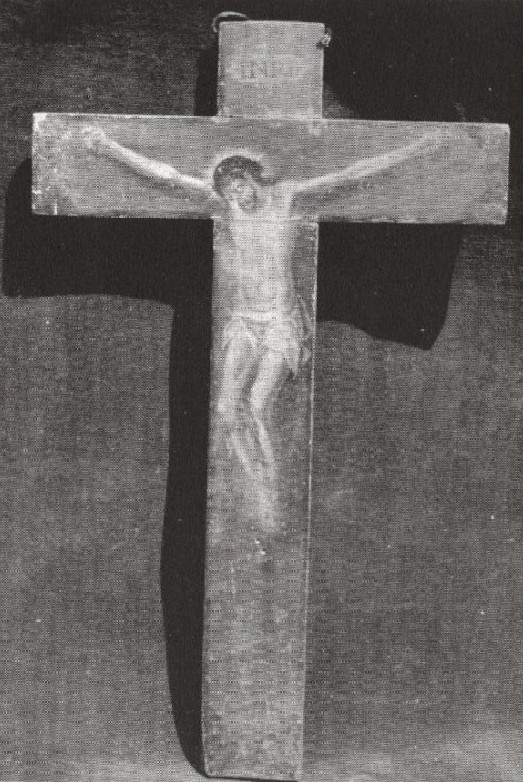
St. Teresa of Avila's Crucifix
|
|
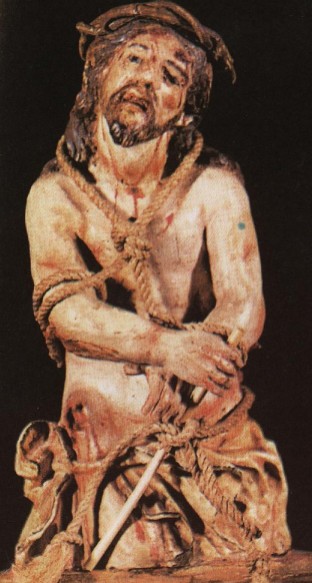
The Ecce Homo of St. Teresa of Avila, Spain 1553.
Teresa was a prayerful as a child, but her fervor languished during her adolescence due to her fascination with the romantic literature of her day. After a serious illness, however, her devotion was rekindled through the influence of a pious uncle. She became interested in the religious life and entered the Carmelite Convent of the Incarnation in Avila in the year 1536. Under a relaxed rule, the nuns of this convent were permitted a great deal of socializing and other privileges that were contrary to the original rule. During the first 17 years of her religious life, Teresa tried to enjoy both the delights of prayer and the pleasures of the secular conversation. Finally, one day in the year of 1553, she had what one writer calls a "shatterring experience." The Saint tells us of her experience in Chapter IX of her autobiography:It happened that, entering the oratory one day, I saw an image which had been procured for a certain festival that was observed in the house and had been taken there to be kept for that purpose. It represented Christ sorely wounded; and so conductive was it to devotion that when I looked at it I was deeply moved to see Him thus, so well did it picture what He suffered for us. So great was my distress when I thought how ill I had repaid Him for those wounds that I felt as if my heart were breaking, and I threw myself down beside Him, shedding floods of tears and begging Him to give me strength once for all so that I would not rise from that spot until He had granted me what I was beseeching of Him. And I feel sure that this did me good, for from that time onward I began to improve (in prayer and virtue). The Saint progressed rapidly in virtue following this experience and she soon began enjoying visions and ecstasies. Finding the relaxed atmosphere of the convent in opposition to the spirit of prayer for which she felt Our Lord had intended the Order, she began reforming its laxities in 1562 at the cost of count-less persecutions and difficulties. Her good friend and advisor, St.John of the Cross, aided her in this endeavor and extended the reform to the friars of the Order. Under the rigorous interpretation of the rule, she attained the heights of mysticism, enjoyed countless visions and experienced various mystical favors. There seems to be no phenomenon peculiar to the mystical state that she did not experience, yet she remained a shrewd businesswoman, administrator, writer, spiritual counselor and foundress. Never a healthy woman, the Saint died of her many afflictions on October 4, 1582 at the convent at Alba de Tormes. Canonized in 1622, she, as well as the Discalced Carmelite Order, was honored when Pope Paul VI officially annexed her name to the list of Doctors of the Church. She is the first woman to join this distinguished group.
|