The Myrrh streaming Icon of The Iveron Mother of God
|
|
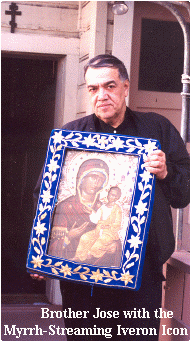
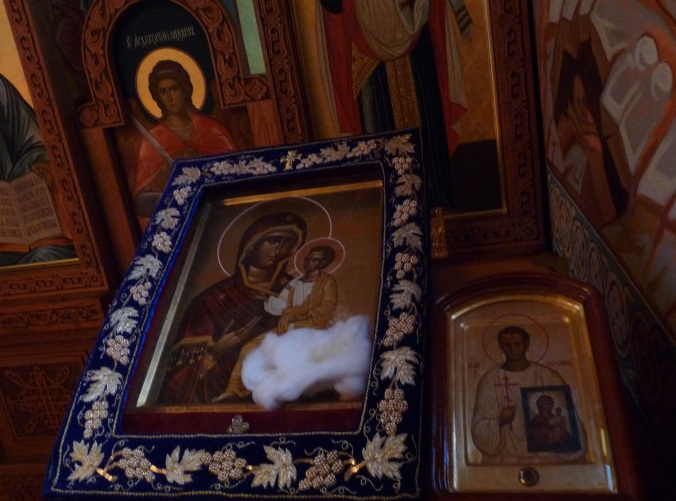
In 1982, a Chilean convert to Orthodoxy, Jose Munoz, in the company of two friends, embarked from Canada to the ancient bastion of Orthodox monasticism, Mt. Athos, on a pilgrimage. An art teacher by profession, he is also an iconographer, and therefore wished to visit some of the sketes (small monastic communities dependent upon one of the 20 major monasteries of Athos) and monasteries which specialize in icon painting. One of the friends who had accompanied Jose decided to become a monk and remained on Mt. Athos in one of the smaller sketes; Jose and his other companion directed themselves towards the Danilov skete, where icons are painted in the ancient Byzantine style using the egg tempera technique. After eight hours of climbing uphill on rough terrain, they were very tired and decided to stop at a skete which they could see on the the Mountainside below. This skete, dedicated to the Nativity of Christ, is very poor and its 14 monks keep a strict monastic rule. The abbot, Fr. Klimentos, greeted them warmly and offered traditional Athonite hospitality. Then he took them to see the skete's icon-painting studio. As soon as he entered the studio, Jose felt an immediate and indescribable attraction to a copy of the Iveron Icon of the Virgin Mary which hung on one of the walls. As he later explained, his heart felt as though it had 'leaped or turned over." He asked whether he could buy this Icon, but was told repeatedly that it was one of the first icons which had been painted at this skete (by one Fr. Chrysostomos in 1981) and was not for sale at any price. That night at a divine service in the church of the skete, during the singing of the angelic hymn to the Theotokos "It is Meet" (one of the chief prayers of the Orthodox Church to the Virgin Mary), Jose fell to his knees and begged the Virgin Mary to make it possible for him to take the Icon back with him into the world, where "we have need of You." Immediately he felt an assurance that somehow his prayer would be answered. The next morning, as Jose and his friend were about to depart, the abbot appeared holding the Icon and said to Jose that it pleased the Virgin Mary for Her Icon to go with him to North America. Jose and his companion went down the mountain and took the the boat towards Daphne, a port on the western shore of the peninsula. On the way, Jose heard a strong inner voice which bade him: "Go to the Iveron monastery and touch your Icon to the original wonder-working Iveron Icon." This they did. Upon arrival at the Iveron monastery they waited three hours before a monk came to open the church which houses the original "Portaitissa." Jose asked that the protective icon case be opened so that his Icon could be placed upon the original Portaitissa in order to be directly blessed by the Virgin Mary. The monk was suprised, but agreed to Jose's request when it was explained to him that Jose and his companion wished to take the blessing of the Virgin Mary to the West where Her intercession is much needed. Returning to his home in Montreal, Canada, Jose placed the Iveron Virgin Mary in his icon corner, where he also kept relics of the saints from the Kiev Caves monastery and of the Grand Duchess Elizabeth (one of the New Martyrs of Russia). Jose began to read a daily Akathist (hymns of praise) before his newly-acquired Icon. At about 4 a.m. on Nov. 24, 1982 (three weeks after his return from Mt. Athos), Jose woke up to the smell of a very strong fragrance, as though someone had spilled a bottle of exquisite perfume. He thought at first that the fragrance emanated from the relics but later, when he stood before the Icon to say his morning prayers, he saw that the hands of the Virgin Mary were streaked with oil. Jose assumed that a friend who was sharing the house had spilled some oil onto the Icon while adjusting the flame of the vigil lamp hanging before it, but the friend denied touching the lamp. When Jose wiped the Icon, he discovered that it was the source of the wonderful fragrance which had by now filled the whole house. Upon the advice of a local Orthodox clergyman, the Icon was taken to church and placed on the altar. During the entire liturgy, myrrh flowed from the hands of the Christ Child. Since that time, with the exception of several days during Holy Week, when the Icon is absolutely dry, the myrrh has continued to flow almost uninterruptedly. (Holy Myrrh is a sweet, fragrant oil which was used in the Old Testament for the anointing of kings. In contemporary Orthodox church practice, a newly born Christian is anointed with Holy Myrrh during which the words "The seal of the gift of the Holy Spirit" are said by the priest.) In the years since, Jose has traveled to many cities and parishes where the Icon has been venerated to the great joy and consolation of the faithful. Wherever the Icon goes, there are always many questions. Some people initially have doubts. A scientist in Miami was astounded to see that the back of the Icon remained perfectly dry. He later surreptitiously chipped off a small piece of the board on which the Icon is painted for scientific analysis: it was found to be ordinary pine wood, nothing more. At some times the myrrh flows in greater abundance than at others. During the consecration of a bishop in Montreal there was such an outpouring of the myrrh that it streamed down from the analogion (lectern on which icons are kept in Orthodox churches) onto the floor. On another occasion, in Florida, the myrrh was seen to rise forth from the hands of the Virgin Mary and the Christ Child as though it were being pressed from within. Nobody has any power to regulate the flow of the myrrh, for apparently it moves to the will of God and His Most Pure Mother. The Icon is kept in a frame about two inches deep and measures about 12 X 18 inches. At first the myrrh flowed only from the hands of the Virgin Mary, from the star on Her left shoulder, and, occasionally, from the hands of Our Lord Jesus Christ. Yet in March 1985, during a Lenten service, even the frame and glass of the Icon began to exude myrrh in such quantities that the cloth of the analogion on which it lay was totally saturated. There is always a layer of cotton wool at the base of the Icon to absorb the myrrh: pieces of this cotton are distributed to the faithful. Although there have already been several cases of physical healing (not only among Orthodox, but Catholics and Protestants, too), the purpose of the Virgin Mary seems to be directed more at the healing of souls. Many who have stood before the Icon have testified to this, experiencing not only compunction and repentance, but consolation at the same time. As mentioned earlier, the flow of myrrh ceases during Holy Week. It ceases on Holy Monday. After the liturgy on the morning of Great Saturday, a light dew of myrrh forms on the Icon, its case and protecting glass. During Matins (the midnight service at which the glorious Resurrection of Our Lord is proclaimed), when the procession of clergy and faithful, holding icons and banners, leaves the church, the Icon begins to exude myrrh in such quantities, that it covers the hands of the person who is carrying it. This is not the first time that the Orthodox Church has witnessed such a miracle. In the 19th century the Surety-of-Sinners Icon in Moscow exuded myrrh with which the sick were anointed and received healing. Earlier, there was a myrrhstreaming icon of the Virgin Mary in the Tolga monastery in Yaroslavl, and there have been others. What is the meaning of this extraordinary manifestation of God's grace in our time? It has been observed that in the history of the Church such miracles have occurred in times of great tribulation; we saw this in the Apostolic times, and, more recently, in Russia, where the Church has suffered cruel persecution for 70 years. The miracles strengthen the faithful and prepare them to endure trials. The appearance of the myrrh-streaming Icon in our time may well signify a period of further great trials for the Russian Orthodox Church and, at the same time, offer consolation that the Virgin Mary will be a Protectress of the faithful: Unto whomsoever much is given, of him shall much be required. Least Among the Brethren Jose Munoz formed the desire to become a monk while still a boy in Chile. He became converted to Holy Orthodoxy as a youth and began to lead a monastic life as best he could within the confines of the world, although he did not enter a monastery. Later he moved to Canada and continued to observe this way of life. When the miracle of the myrrh-streaming occurred, Jose vowed that he would never seek worldly gain from the Icon. Therefore any collections taken up during church services at which the Icon is present are sent to the poorest monasteries and sketes on Mt. Athos and/or to help those persecuted for their faith in the Soviet Union and their families. Jose never accepts any money for himself while traveling with the Icon, although he is forced to take much time off from his teaching and icon painting, which are his only sources of gainful employment. When asked why he thinks he was chosen for such a miracle, Jose replies that, knowing his many weaknesses, he is at a loss to explain this; he feels that perhaps it was because God often reveals himself through the very least of His servants, and that as a convert, he feels himself to be the "least among the brethren." He regards himself not as the owner, but merely the custodian of the Icon, which properly belongs to the entire body of the faithful. From his childhood his mother, who is a devout Roman Catholic, taught him to love the Most Pure Virgin, therefore he always prayed to Her, though never asked Her for any signs or miracles. Glory be to Our Lord Jesus Christ for manifesting through Jose, the "least of His servants," the wonder-working Iveron Icon of the Virgin Mary! |